You own a townhouse in San Diego County, or you are responsible for one as an heir, an executor, a trustee or a spouse, and someone now needs a number they can rely on. That someone might be a lender reviewing a refinance, a family court dividing a marriage, a probate court reviewing an estate inventory, or a buyer across the table. The paragraphs below explain what a townhouse appraisal is, when one fits, how the work usually proceeds, and what to gather before you ask for one.
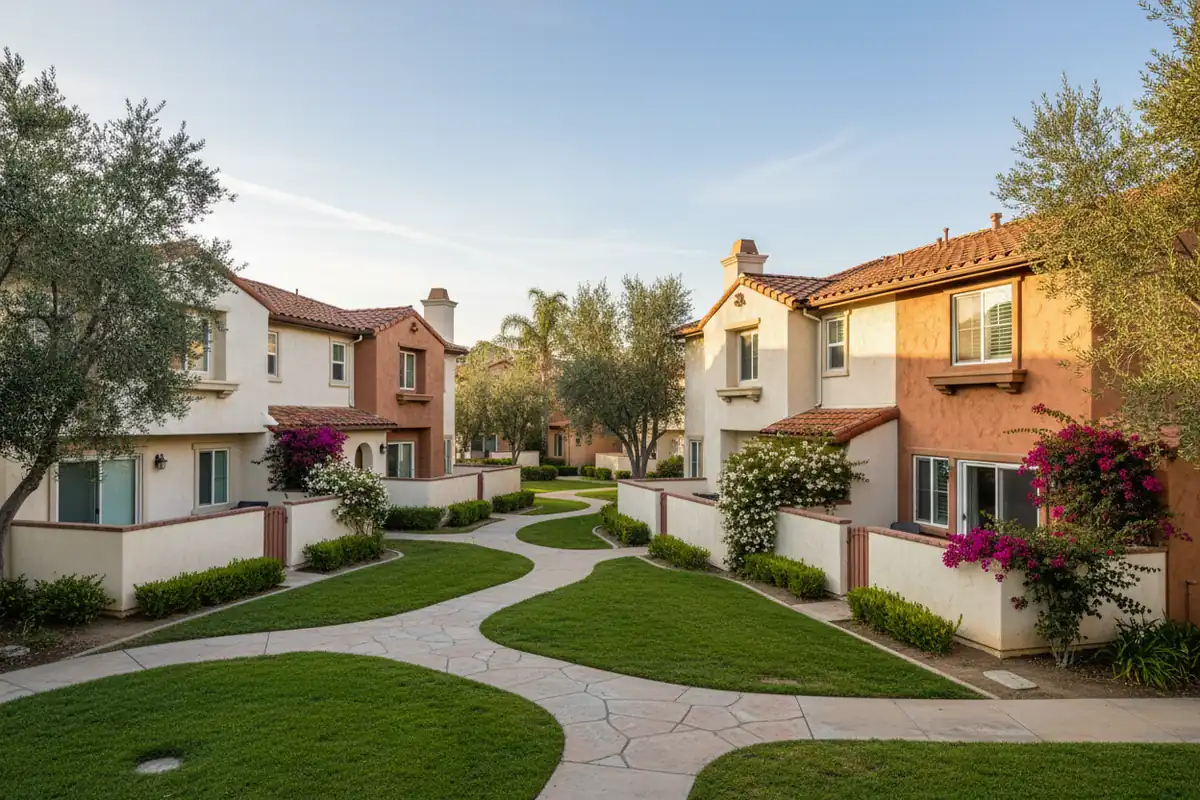
A townhouse appraisal is an independent, written opinion of what a townhouse would likely sell for on the open market. An appraiser prepares it after looking at the unit inside and out and comparing it with recent sales of similar townhouses. It is not an online estimate, a real estate agent's market analysis or the county's assessed value, and it serves different purposes than any of those three.
On this page
Key Takeaways
An appraisal is a documented opinion of market value. An appraiser prepares it for a stated purpose and supports it with an inspection and an analysis of comparable sales. Three other numbers are often confused with it:
- An online home value estimate. A computer model produces this figure from public records and recent sales. It is quick, but no one inspects the home.
- A comparative market analysis (CMA). A real estate agent prepares a CMA from recent nearby sales to help set a listing price. It is not a formal appraisal.
- The assessed value. The San Diego County Assessor sets this figure to calculate property tax under California's property tax rules. It can differ a great deal from today's market value.
A townhouse appraisal is commonly needed for a sale, a refinance, a divorce, an estate or probate matter, the administration of a trust, or a property tax appeal. Among these, California law addresses divorce and probate directly. In a divorce, the court values assets as near as practicable to the time of trial (Family Code section 2552). In probate, the appraisal of property in the estate inventory is made by the people the Probate Code names (Probate Code section 8900).
Lenders often require an appraisal, but not always. The federal rule for national banks requires one generally, with listed exceptions. This site does not state a fee for an appraisal, because what an appraisal costs depends on the property and the assignment.
When a Townhouse Appraisal Fits
The purpose of the valuation determines whether an appraisal is the right tool.
A sale. A seller may want an independent value before choosing a list price. A buyer may want one before making an offer. The appraisal gives either side a documented figure that rests on more than an online estimate.
A refinance. Under 12 C.F.R. § 34.43, an appraisal by a state-credentialed appraiser is required for real estate-related financial transactions, except those in which one of the regulation's listed conditions applies. The exceptions include a residential real estate transaction with a transaction value of $400,000 or less, and a transaction wholly or partially insured or otherwise backed by a United States government agency or a United States government sponsored agency. That figure appears in the eCFR text current as of 2026-11-13. For some of the excepted transactions, the institution must still obtain "an appropriate evaluation" of the real property collateral. Whether a particular loan needs a full appraisal depends on the loan and the lender.
A divorce. Under Family Code section 2552, when a court divides the community estate upon dissolution or legal separation, it "shall value the assets and liabilities as near as practicable to the time of trial." There is one exception. Upon 30 days' notice by the moving party to the other party, the court may, for good cause shown, value all or part of the assets at a date after separation and before trial, to accomplish an equal division in an equitable manner. An appraisal documents the townhouse's value for whichever date applies.
An estate or probate. Probate Code section 8900 provides that the appraisal of property in the inventory shall be made by the personal representative, the probate referee, or an independent appraiser, as that chapter of the Probate Code provides. In addition, Evidence Code section 813 lets the owner, or the owner's spouse, give an opinion of a property's value. More on estate and probate appraisals is available for readers who need it.
A trust or a tax appeal. A trustee may need a documented value for an accounting or a distribution. An owner who disputes the San Diego County Assessor's figure may want independent support for that position.
When co-owners, a lender or a court are already in conflict over the value, that contested matter belongs with an attorney.
How a Townhouse Appraisal Works, Step by Step
The steps follow a familiar order. Each one shapes the opinion of value at the end.
- The request. The owner, or a person with authority over the property, asks for an appraisal quote and states the purpose of the appraisal.
- Property information. Basic facts about the townhouse are gathered: the address, the size, the condition and the homeowners association (HOA) that governs it.
- The inspection. The appraiser visits the property and does look inside the home. The appraiser notes the layout, the finishes, the condition and any improvements, as well as the exterior and the setting.
- The comparable sales analysis. The appraiser looks for recent sales of similar townhouses nearby and adjusts for the differences between those homes and this one.
- The report. The appraiser produces a written report that states the opinion of value and explains how the appraiser reached it.
Townhouses raise questions that a detached house does not:
- Shared walls. Shared walls affect privacy and noise, and buyers notice both.
- HOA dues and financial health. The monthly dues, any special assessments and the association's reserves can affect what buyers will pay.
- Common areas. Pools, landscaping and recreation spaces change what counts as a true comparable.
- Parking. A garage, assigned spaces or street parking can separate one unit from another.
- Ownership type. A townhouse typically means the owner holds the unit and the land beneath it. How the property is held matters when the appraiser chooses comparable sales.
The general principles of residential property appraisals apply to townhouses, with these added factors.
Costs, Timing and Trade-offs
An appraisal costs money and takes time. The amount of each depends on the property and the assignment, and this site states no fee or number of days.
Cost. The price varies with how complex the property is, the scope of the assignment and the appraiser who takes it on. A quote for the specific townhouse is the reliable way to learn the figure.
Timing. A townhouse can take longer to appraise than a detached house when few similar townhouses have sold nearby. The appraiser may then search a wider area or make larger adjustments for differences in location, amenities or HOA structure.
What can lower an appraised value. Several factors can pull the figure down, including:
- deferred maintenance or visible damage
- location features that differ from those of the comparable sales
- few recent sales of similar townhouses
- HOA financial problems or large special assessments
- features that set the unit apart from nearby sales, such as a smaller footprint or less parking
Whether it is worth the cost. An appraisal produces a documented, independent opinion that an online estimate or a CMA does not. Whether that is what the situation needs depends on the purpose. A pricing question may need less than a court proceeding, a lender review or a tax appeal does.
Owners in a divorce or an estate are often working against a court schedule, so the trade-off between time and documentation can feel sharper there. Those court rules are explained above and are not repeated here.
Options to Compare
Each valuation tool answers a different question. The table sets them side by side.
| Tool | Who produces it | Typical use | Limits |
|---|---|---|---|
| Independent appraisal | An appraiser | Lending, court matters, estates, tax appeals, pricing | Costs money and takes time |
| Online estimate | An automated model | A quick sense of the range | No inspection; can be off where townhouse sales are sparse |
| Comparative market analysis | A real estate agent | Setting a list price | Not a formal appraisal |
| Assessed value | San Diego County Assessor | Calculating property tax | Can differ a great deal from market value |
An online estimate is free to view and takes moments. Its accuracy depends on how much recent, similar sales data exists, and that can be thin for townhouses in parts of San Diego County. A CMA reflects an agent's reading of the local market, which helps when choosing a list price. The assessed value reflects California's property tax rules, not a current sale.
An appraisal is the slowest and most formal of the four. It is also the one built to serve as documented evidence of value. A home value review by address is a different, informal tool, and it is not an appraisal. Comparing the purpose of each tool against what the situation actually requires is how an owner decides which one fits. The broader guide what is my home worth lays out these tools in more depth.
What to Have Ready
A complete picture of the townhouse helps the appraiser scope the assignment correctly. Useful items include:
- Basic details. The address, the square footage, the number of bedrooms and bathrooms, and the year built.
- HOA documents. The monthly dues, any special assessments, and the association's financial statements if you have them.
- Improvements. The dates and descriptions of renovations. Dollar amounts help only if you know them.
- Prior appraisals. Any earlier appraisal of the property, if one exists.
- The purpose. Sale, refinance, divorce, estate, probate, trust or tax appeal. The scope of the assignment depends on it.
- For an estate or probate. The date of death and the details of the court case, which the person handling the estate will have.
- For a divorce. Which valuation date applies under Family Code section 2552, as described above.
A practical next step is to find the HOA's most recent statement of dues and assessments and to note which purpose the appraisal will serve. Looking up the property's record with the San Diego County Assessor is another.
Local Context: Townhouse Appraisals in San Diego County
Townhouses are found throughout San Diego County. They appear in Chula Vista, El Cajon, Escondido, La Mesa, National City, Oceanside, San Marcos, Santee and Vista, as well as in urban neighborhoods of the City of San Diego.
The number of townhouses varies from one submarket to the next. In some communities, recent comparable sales are plentiful. In others, the appraiser may need to search beyond the immediate neighborhood and adjust for differences in location, amenities or the way the HOA is structured. The townhouse's address alone can therefore shape how the comparable sales analysis unfolds.
The San Diego County Assessor-Recorder-County Clerk keeps the property records that an appraiser draws on during research. These include ownership and recording details for the parcel.
The California Bureau of Real Estate Appraisers is the state agency that oversees appraiser credentials in California. An owner can ask any appraiser which credential they hold. More on San Diego property appraisals is available for owners elsewhere in the county.
Take the next step
Ready to take the next step with your property?
Tell us about the property and why you need an appraisal, so an independent appraiser can confirm the right scope of work.
How it works
- The propertyIts address and its type.
- The purposeA sale, an estate or probate, a divorce, a trust, tax or a legal matter.
- Your timelineWhen the appraisal is needed.
Take the next step
How we work
- Every request is reviewed by a person. Nothing on this site calculates a value automatically.
- Appraisals are prepared by independent, state-licensed or certified appraisers, never by this website.
- Estimates and cash offers are clearly labeled — never presented as appraisals.
- A request does not commit you to anything.
Frequently asked questions
Is a home appraisal worth it?
It depends on the purpose. An appraisal produces a documented, independent opinion of value that an online estimate or an agent's market analysis does not. Lenders and court matters commonly ask for that kind of documentation, while a simple pricing question may need less.
What devalues a home appraisal?
Several factors can lower an appraised value. They include deferred maintenance or damage, few recent sales of similar townhouses, HOA financial problems or large special assessments, location differences, and features that differ from the comparable sales, such as less parking.
How much does it cost to get a townhouse appraised?
The cost varies with the property's complexity, the scope of the assignment and the appraiser. This page states no dollar range. A quote for the specific townhouse is the reliable way to learn the figure.
Do appraisers look inside a townhouse?
Yes, a standard appraisal includes an interior and exterior inspection of the condition, layout, finishes and improvements. Some limited-scope assignments use exterior-only or desktop methods. The client's or lender's instructions define those assignments.
How does a townhouse appraisal differ from a condominium appraisal?
A townhouse typically means owning the unit and the land beneath it, which can set it apart from a condominium. That difference shapes which comparable sales the appraiser uses and how HOA dues and common areas are analyzed.
What is the difference between an appraisal and the San Diego County Assessor's assessed value?
The assessed value is used to calculate property tax and can differ a great deal from market value. An appraisal is a separate opinion of market value, prepared for a specific purpose. The two come from different processes.
When is an appraisal required for a California divorce?
Family Code section 2552 requires the court to value assets as near as practicable to the time of trial, with the good-cause exception described above. An appraisal is one way to document the townhouse's value for that date. A contested valuation is a matter for an attorney.
Is an appraisal required for a California probate or estate matter?
Probate Code section 8900 names who makes the inventory appraisal, and Evidence Code section 813 lets the owner give value. Which method applies depends on the estate's circumstances and the court's instructions.