You own a duplex in San Diego County, or you are about to own one through an estate, a trust or a divorce. You need a number you can stand behind, whether for a sale, a refinance, a settlement between family members or a question about the property tax bill. Two units mean two leases, two sets of tenants or one tenant and your own household. They also make "what is it worth" harder to answer than it is for a single-family house. This page lays out how a duplex valuation works, when a market review fits, when a formal appraisal is needed instead, and what to gather first.
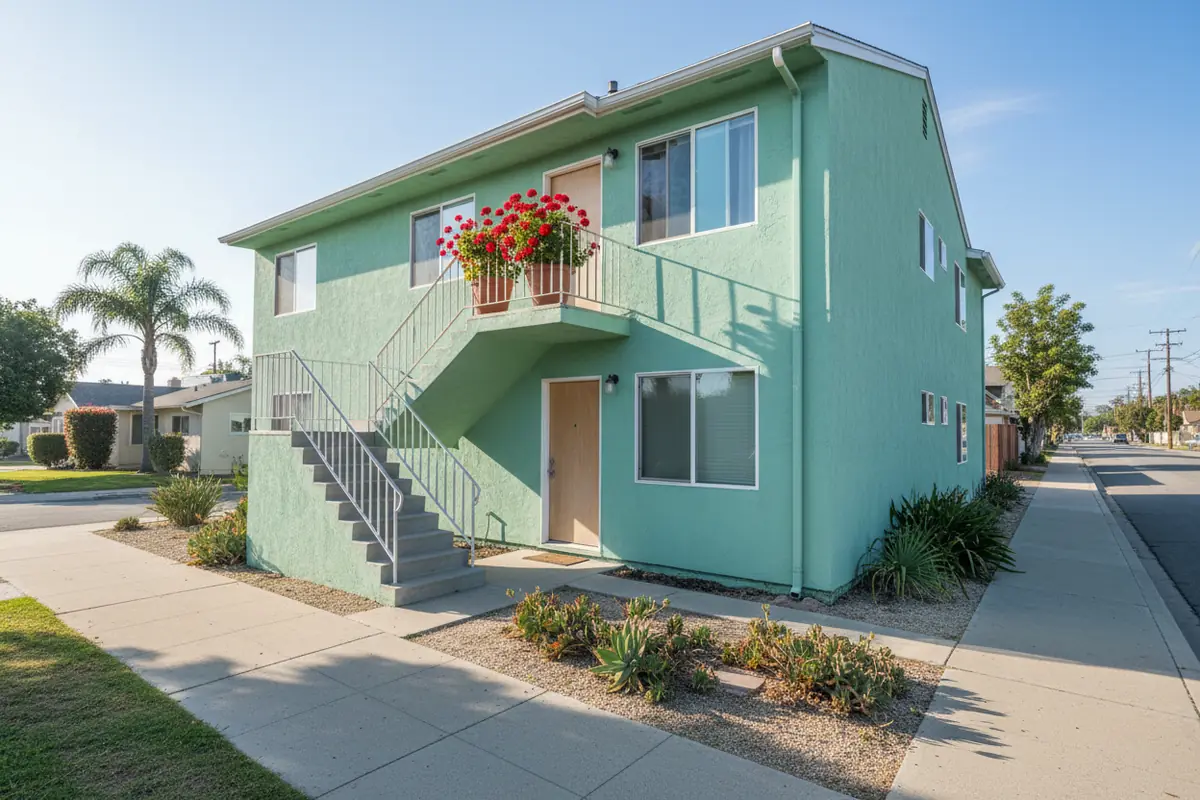
A duplex is valued on two things: what similar two-unit properties nearby have recently sold for, and the rent its two units bring in or could bring in. A local market review, also called a comparative market analysis or CMA, combines both into a reasoned estimate of market value. It is not an appraisal and not an instant online estimate.
On this page
Key Takeaways
- Two units, two sources of value. A duplex has two rentable units. Its market value depends on comparable sales and on the income the units produce.
- A market review is an opinion, not a formal report. A local market review draws on recent sales of comparable duplexes and current rental data. It differs both from a formal appraisal report and from an automated valuation model, the computer-generated estimate many websites show.
- Three approaches to value. Value is estimated by the sales comparison approach, the income approach and the cost approach. A market review for a duplex usually relies on the first two.
- Location matters within the county. Coastal, urban-core and inland submarkets can produce different results for duplexes that otherwise look alike. A duplex in Pacific Beach, one in City Heights and one in Escondido are not compared to the same sales.
- Assessed value is a separate number. The San Diego County Assessor sets assessed value for property tax under Proposition 13. Assessed value is a tax base, not a measure of market value.
- The comparable pool is changing. State laws on lot splits (SB 9) and accessory dwelling units (ADUs) have added two-unit and small multi-unit properties in the county. That changes which sales count as comparable.
When This Option Fits
A market review fits when a current, reasoned estimate of market value will inform a decision. Examples include setting a list price, negotiating with a buyer or a co-heir, preparing an estate inventory, keeping a trust accounting, or deciding whether to question a property tax assessment. Before a listing, the same logic applies as in a pre-listing home valuation. For a trust, it sits alongside the questions covered under trust property appraisal.
Some situations call for a formal appraisal instead. A formal appraisal is a written report prepared by a California state-certified or state-credentialed appraiser under the Uniform Standards of Professional Appraisal Practice (USPAP), the national standards appraisers follow. Lenders require one for a mortgage or a refinance. In a probate, "The probate referee shall appraise all property other than that appraised by the personal representative." A divorce proceeding often uses one when a court will rely on the figure, which is the subject of a divorce real estate appraisal. The dividing line is who will rely on the number: an owner or the parties themselves can work from a market review, while a lender, a court or a formal estate or divorce filing looks for the defined standard behind an appraisal.
How the duplex is used also changes the answer:
- Owner-occupied duplex. When the owner lives in one unit, the sales comparison approach usually anchors the estimate.
- Fully rented duplex. When both units are rented at market rates, the income approach carries more of the value.
Lender guidelines, including Fannie Mae's, treat a two-unit property differently from a single-family home. That matters for a refinance, or for a sale to a buyer who will finance the purchase.
How It Works, Step by Step
A duplex market review moves from facts about the property, to the market around it, to a single estimate. Here is the usual order.
- Property information. The review starts with the property itself: the size of each unit, lot size, year built, condition, current rents or vacancy, and any recent permits or ADU additions.
- Comparable sales. Next come recent sales of two-unit properties in the same San Diego County submarket. Each sale is adjusted for differences in size, condition, location and unit layout. Two one-bedroom units on a small Chula Vista lot are not treated the same as a three-bedroom-over-two-bedroom duplex near North Park, even at similar square footage.
- Rental income analysis. Current or market-rate rent for each unit is set against comparable income-producing properties in the area. Two common tools help here. The gross rent multiplier (GRM) is the ratio of a property's sale price to its gross annual rent. The capitalization rate is net operating income divided by value.
- Reconciliation. The sales comparison result and the income result are compared and brought together into one market value estimate. How much each counts depends on the property's rental situation and how good the data is.
- Delivered review. The finished product is a written local market review that sets out the comparable sales, the rental analysis and the reconciled estimate.
An SB 9 lot split or an ADU conversion can change which comparable sales apply. Part of the work is identifying the most relevant pool of sales for the property's current setup. A home with an added unit raises questions also discussed under ADU appraisal. The market review figure and the county's assessed value, covered under Local Context below, are different numbers that serve different purposes.
Costs, Timing and Trade-offs
Several features of the property make a duplex review simpler or more involved:
- whether there are two units or more
- whether current rents are at market rates or well below them
- how many comparable two-unit sales exist in the submarket
- whether an ADU or SB 9 conversion is part of the picture
A duplex in an inland neighborhood of El Cajon with steady comparable sales is a different task from an unusual coastal property in Ocean Beach with few close matches.
A market review generally costs less and takes less time to produce than an appraisal. It does not require the formal inspection and USPAP-compliant report that an appraisal does. What drives an appraisal fee is discussed under home appraisal cost.
The trade-off runs the other way on reliance. If the figure will be tested by someone with a stake in a different answer, the lighter process of a market review becomes a limit rather than a convenience. For a property tax appeal before the San Diego County Assessment Appeals Board, that board decides what valuation evidence it accepts, and it is the place to confirm whether a market review is enough in a given situation.
Options to Compare
Four kinds of figures get called "the value" of a duplex. Each has a genuine use and a real limit.
| Option | Who produces it | Fits | Limits |
|---|---|---|---|
| Local market review (CMA) | A real estate professional or a valuation service | Pricing, negotiation, informal estate or trust purposes | Lacks the formal standard lenders and courts look for |
| Appraisal | A California state-certified or state-credentialed appraiser | Lender loans, court matters, formal estate and divorce proceedings | More formal process; scope tied to its stated purpose |
| Automated valuation model (AVM) | An algorithm using public records and sales data | A quick starting point | Least reliable for a duplex, because income data and unit layout are often missing from public records |
| Assessed value | San Diego County Assessor, under Proposition 13 base-year rules | Property tax | Reflects a tax base, not current market value |
A lender requirement, a court proceeding, a sale decision and an estate inventory each point toward a different tool. A single-family home valuation follows the same distinctions, with one difference for a duplex: the rent from two units adds the income approach to the comparison.
What to Have Ready
A duplex review rests on documents that the owner, or the estate or trust, usually already holds:
- Leases or rent amounts. Current lease agreements or monthly rents for each unit, or the unit's vacancy status.
- Expense records. Recent utility bills or expense records, if the owner pays any utilities.
- Property tax bill. The current bill, which shows the assessed value and the Assessor's Parcel Number (APN), the county's identifying number for the parcel.
- Permits. Any permits for ADU additions, SB 9 conversions or recent renovations.
- Title or deed. The deed, or another title document, showing how ownership is held: a sole owner, co-owners, a trust or an estate. This also shows who holds the authority to act on the property.
- HOA documents. Homeowners association documents, if the duplex sits in a planned development.
Unpermitted work, a long-term tenant paying well below market, or a unit used as an owner's home each change how much the sales and income results count. A review is more accurate when these are noted plainly rather than left out.
Local Context
San Diego County is several duplex markets, not one. Duplex values differ among three broad groups:
- Coastal communities: La Jolla, Pacific Beach, Ocean Beach, Encinitas and Carlsbad.
- Urban core neighborhoods: North Park, South Park, City Heights, Logan Heights and Barrio Logan.
- Inland cities: El Cajon, Santee, Escondido, Vista and San Marcos.
National City, Chula Vista and the wider South Bay corridor have a duplex inventory of their own, different from both the coast and the urban core. A comparable sale in Oceanside may say little about a duplex in Santee.
California's SB 9 allows qualifying single-family lots to be split and developed with additional units. Together with the state's ADU laws, it has added two-unit properties across the county. That shifts which recent sales are true comparables.
The San Diego County Assessor-Recorder-County Clerk keeps the public parcel data, assessed values and recorded documents. Its records are the authoritative source for a property's tax base and ownership record. Under Proposition 13 and the Revenue and Taxation Code, annual increases in assessed value are limited. A change of ownership or new construction leads to a reassessment, which matters when a duplex is sold, inherited or substantially improved. The Assessor's office publishes the current rules.
A natural next step is the duplex's current property tax bill and its parcel record from the Assessor-Recorder-County Clerk. Together they give the APN, the assessed value and the recorded square footage, so the market estimate can be compared against the county's own record.
Take the next step
Ready to take the next step with your property?
Answer a few questions and receive a reviewed market value estimate for your property.
How it works
- The propertyIts address, type, size, bedrooms and bathrooms.
- Its conditionFrom recently updated to needing significant work.
- Your reasonCurious, selling, refinancing or planning an estate.
Take the next step
How we work
- Every request is reviewed by a person. Nothing on this site calculates a value automatically.
- Appraisals are prepared by independent, state-licensed or certified appraisers, never by this website.
- Estimates and cash offers are clearly labeled — never presented as appraisals.
- A request does not commit you to anything.
Frequently asked questions
What is the difference between a duplex market review and a formal appraisal?
A market review is an opinion of value built from comparable sales and rental data. An appraisal is a formal report prepared by a California state-certified or state-credentialed appraiser under USPAP. Lenders, courts and formal divorce proceedings call for the appraisal, not the market review.
Does the income from both units affect a duplex's value?
Yes. When both units are rented at or near market rates, the income approach, using a gross rent multiplier or a capitalization rate, counts heavily alongside comparable sales. When one unit is owner-occupied, comparable sales usually anchor the estimate.
How does Proposition 13 affect a duplex's assessed value in San Diego County?
The San Diego County Assessor sets assessed value under Proposition 13 base-year rules, which limit annual increases. A change of ownership or new construction leads to reassessment. The result is a tax base, not the property's current market value.
Does an SB 9 conversion or ADU addition change how a duplex is valued?
It can. A lot split or an added unit can change the unit count, the permitted use and the comparable sales that apply. New construction also leads to a reassessment by the Assessor for the added improvement.
Can a market review be used for a property tax appeal in San Diego County?
That depends on the San Diego County Assessment Appeals Board, which sets its own rules on valuation evidence. A market review may help an owner frame an informal question. The board is the place to confirm whether a formal hearing calls for an appraisal.
What is the difference between a duplex's market value and its assessed value?
Market value estimates what a willing buyer would pay a willing seller in an arm's-length sale on a given date. Assessed value is the Assessor's property tax figure, based on a base year and annual limits. The two serve different purposes and often differ.
Which valuation approach is used for a duplex — sales comparison, income, or cost?
Sales comparison and income usually carry the estimate for a duplex. The cost approach, which is land value plus the depreciated cost of replacing the buildings, is less often the main indicator. It may be considered when comparable sales are scarce.
Do I need a formal appraisal or a market review for a divorce or estate matter?
Where a court will rely on the figure, as in a contested divorce, an appraisal is typically required; a probate inventory goes to "the probate referee designated by the court." A market review may serve an informal inventory or a negotiation the parties agree on. The attorney handling the matter can confirm the format.