You own a triplex or fourplex in San Diego County, or you are about to. Now a sale, a refinance, an estate, a trust, a divorce or a property tax question needs a number that stands on its own. The building has tenants, leases and rent that has to be counted, and a single-family estimate from an online tool does not reflect any of that. This page lays out what the appraisal involves, when it fits, and what to compare it with.
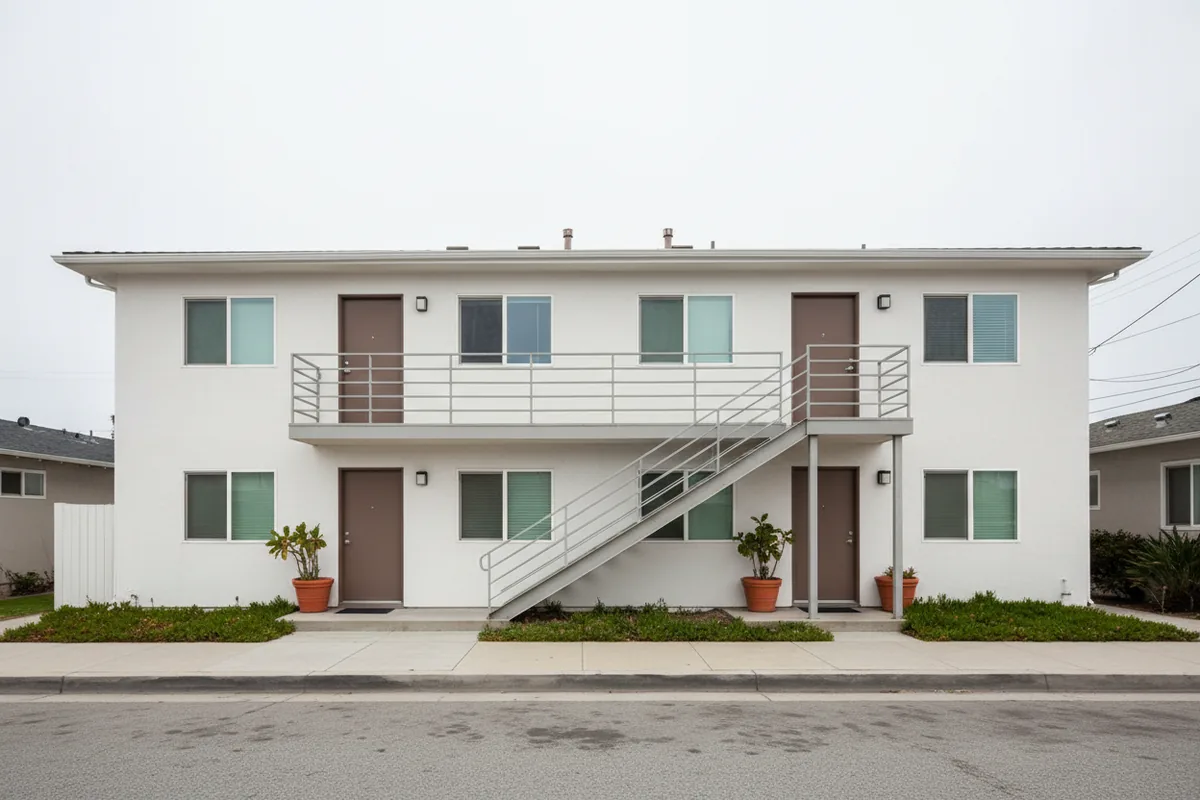
A triplex or fourplex appraisal is an appraiser's written opinion of what a three- or four-unit residential building is worth. It looks at recent sales of similar small multi-unit properties and at the rent the units produce. For a loan, the report is usually prepared on the Fannie Mae Small Residential Income Property Appraisal Report, known as Form 1025.
On this page
Key Takeaways
- Category. A triplex has three units and a fourplex has four. Both fall into a category often called small residential income property, which sits between single-family homes and the larger apartment buildings treated as commercial property.
- Two lines of evidence. A single-family appraisal relies mainly on comparable sales, meaning recent sales of similar homes nearby. For a triplex or fourplex, the appraiser also weighs the income the units produce: the rents, the leases and the vacancies.
- The lending form. Form 1025 is the standard lending report for two- to four-unit properties.
- Local rents matter. A fourplex in Oceanside and a fourplex in El Cajon can rest on quite different rent evidence.
When This Option Fits
A formal appraisal usually comes up when someone outside the owner's household needs an independent value. These are the common situations:
- A sale or purchase. An appraisal gives a value opinion that is separate from a listing price or a buyer's offer. The process for an owner selling without a lender involved is described under appraisal for private sale.
- A refinance or cash-out refinance. Lenders typically require an appraisal of the property as collateral for the loan.
- An estate, probate or trust administration. A date-of-death or retrospective appraisal may be needed to establish fair market value for tax or distribution purposes. A retrospective appraisal values the property as of a past date. Related questions are discussed under trust property appraisal.
- A divorce or legal separation. When a triplex or fourplex is a marital asset, an independent appraisal gives both spouses a common figure to work from when dividing it.
- A property tax appeal. An owner who believes the San Diego County Assessor's assessed value is too high may use an independent appraisal as supporting evidence.
Valuing a larger apartment building with five or more units is a separate commercial subject.
How It Works, Step by Step
The process for a triplex or fourplex follows a recognizable order, with more steps tied to income than a house appraisal has.
- The request. The owner or another requesting party asks for an appraisal. This could be an executor, a trustee, a spouse's attorney or a lender. The usual starting details are the property address, the number of units and the purpose of the appraisal.
- The inspection. The appraiser looks at the exterior and at the interior of each unit. The appraiser notes condition, amenities and any deferred maintenance, which means repairs that have been put off. Access to occupied units has to be arranged with the tenants.
- The research. The appraiser looks for comparable sales of similar three- and four-unit properties in the area. Because the building produces income, the appraiser also examines its rental income and expenses.
- The analysis. An appraiser can use three approaches to value. The sales comparison approach compares the property with similar sales. The income approach estimates value from what the property earns, so the rents, the vacancies and the expenses gathered in the research step feed directly into the value conclusion rather than serving only as background. The cost approach estimates what it would cost to replace the buildings. For small income properties, the first two are typically used and considered together, and the cost approach may also be considered.
- The report. The appraiser puts the conclusion in a written report, typically Form 1025 when a lender is involved.
- Delivery. The completed report goes to the party who ordered it.
Costs, Timing and Trade-offs
Fees for small income properties vary. Several things shape the fee:
- the size of the building and its number of units
- its condition
- how complex the income analysis is
- whether the appraisal is for a lender or for another purpose
These factors are discussed further under home appraisal cost.
Timing also varies. It depends on when an appraiser is available, how quickly every unit can be reached, and how hard it is to find comparable sales in that part of the county. A comparable sale is easier to find for a building with a common layout. For a building with an unusual layout or mix of units, the search can take longer, a challenge also described under appraisal for unique homes.
Two features make this work more involved than a single-family appraisal. First, the income approach requires gathering rent rolls, lease terms and vacancy information. A rent roll is a list of each unit and its rent. Second, for estate, probate and other retrospective appraisals, the appraiser also researches market conditions as they stood on the valuation date. That added research widens the scope of the assignment.
The trade-off is plain. A formal appraisal takes more time and preparation than an online estimate. In exchange, it gives a signed, documented opinion that is built to stand up to review.
Options to Compare
Several kinds of value figures circulate for any property. Each one serves a different purpose, and only one of them is an appraisal.
| Option | What it is | What it is used for | Where it falls short |
|---|---|---|---|
| Automated valuation model (AVM) | A computer-generated estimate built from public records and algorithms | A quick, rough reference point | It is not an appraisal, and no one inspects the units or reads the leases |
| Online home value estimate | A figure from a consumer website, usually produced by an AVM | Getting a general sense of a range | It has the same limits as an AVM and often reads a multi-unit building poorly |
| Comparative market analysis (CMA) | A real estate agent's review of recent comparable sales | Setting or testing a listing price | It is not an appraisal and is not signed by an appraiser |
| Assessed value | The value the San Diego County Assessor assigns for property tax purposes under Proposition 13 | Calculating the property tax bill | It is a separate concept from market value and serves a separate purpose |
| Formal appraisal | A signed, documented opinion of value prepared by an appraiser | Lending, court, estate and tax matters | It takes more time and preparation |
When a lender, a court or a tax filing needs a formal value opinion, the document typically called for is an appraisal rather than an estimate or a CMA. San Diego Home Appraisal & Valuation is not an appraiser and does not set a property's value. A reader can request an appraisal quote through its form.
What to Have Ready
An income-property appraisal moves on paperwork as much as on the inspection. These items are typically useful:
- A current rent roll. It lists the monthly rent for each unit, whether the unit is occupied, and the lease term.
- Copies of current leases or rental agreements.
- Utility records. Recent utility bills, or a note of which utilities the owner pays and which the tenants pay.
- Improvement records. Records of recent repairs, renovations or capital improvements, with approximate costs.
- The APN. This is the Assessor's Parcel Number, the county's identifying number for the parcel. It is available from the San Diego County Assessor-Recorder-County Clerk.
- For an estate or probate matter. The date of death, or whichever valuation date is needed.
- For a property tax appeal. The current assessment notice from the San Diego County Assessor.
Local Context
San Diego County's triplexes and fourplexes sit in many different settings. In the city of San Diego they cluster in older neighborhoods such as North Park, South Park, University Heights, City Heights and Logan Heights. South of the city, National City and Chula Vista have their own stock of small multi-unit buildings, and some questions specific to that city are covered under Chula Vista property appraisals. Inland, El Cajon has many of them, and Oceanside does too in North County.
The rental market behind those buildings is not uniform. Coastal and inland submarkets differ. So does closeness to employment centers and to transit. An appraiser applying the income approach examines those local conditions. A fourplex in University Heights is compared with rent evidence near University Heights, not with a fourplex in El Cajon or Oceanside.
The San Diego County Assessor-Recorder-County Clerk, known as the ARCC, administers property assessments and is the official source for assessed value and APN lookups. Under Proposition 13, assessed value is set under rules that do not simply follow current market value. For that reason, the assessed value of a long-held fourplex in North Park, City Heights or National City can be quite different from what the building would sell for today.
The rent roll and a copy of each lease are usually the first things an appraiser asks for on a building with tenants.
Take the next step
Ready to take the next step with your property?
Tell us about the property and why you need an appraisal, so an independent appraiser can confirm the right scope of work.
How it works
- The propertyIts address and its type.
- The purposeA sale, an estate or probate, a divorce, a trust, tax or a legal matter.
- Your timelineWhen the appraisal is needed.
Take the next step
How we work
- Every request is reviewed by a person. Nothing on this site calculates a value automatically.
- Appraisals are prepared by independent, state-licensed or certified appraisers, never by this website.
- Estimates and cash offers are clearly labeled — never presented as appraisals.
- A request does not commit you to anything.
Frequently asked questions
What does a property appraisal include?
A property appraisal includes a physical inspection, a review of comparable sales, and a written report stating the appraiser's opinion of value. For a triplex or fourplex, the report also covers an income analysis of the rents, expenses and vacancies, alongside the sales comparison.
What are the three types of appraisals?
The three standard approaches to value are sales comparison, income and cost. Sales comparison looks at similar recent sales. The income approach looks at what the property earns. The cost approach estimates what it would cost to replace the buildings. A triplex or fourplex appraisal typically uses both sales comparison and income.
How does a triplex or fourplex appraisal differ from a single-family appraisal?
It is more involved. Along with comparable sales, the appraiser analyzes the rents, the leases and the expenses. For lending, the report is usually Fannie Mae Form 1025 rather than the form used for single-family homes.
What is the Fannie Mae Form 1025?
Form 1025 is the Fannie Mae Small Residential Income Property Appraisal Report. It is the standard form for two- to four-unit residential income properties in most lending transactions. It captures both the sales comparison and the income approaches, and most lenders financing a triplex or fourplex call for it.
Can I get my property appraised for free?
Not in the formal sense. An appraisal accepted for lending, court or tax purposes is a professional report prepared by an appraiser. Free online estimates and AVMs are computer-generated figures, not appraisals, and they are not used for those purposes.
How does assessed value differ from appraised value?
The two serve different purposes. Assessed value is what the San Diego County Assessor assigns for property tax purposes under Proposition 13, and it can differ widely from market value. Appraised value is an appraiser's independent opinion of what the property would sell for.
What not to say to an appraiser?
A desired value or a target number is the thing to leave out. An appraiser forms an independent opinion and is not an advocate for any figure. Accurate facts help the appraiser: current rents, lease terms and recent improvements. Pressing for a particular conclusion does not change the appraiser's duty to stay independent.
When is a triplex or fourplex appraisal needed for an estate or probate matter?
It is typically needed when the building is part of an estate and its fair market value as of the date of death must be established for tax or distribution purposes. The appraisal reflects conditions on that valuation date, even when the date is in the past.