A duplex in San Diego County may be the family home with a rented unit next door, a parent's estate, a trust asset, or the largest thing a couple owns together. A sale, a refinance, a probate inventory, a divorce or a question about the property tax bill now needs a number that others will accept, and an online estimate or an agent's opinion may not be enough. What follows lays out how a duplex appraisal works, when it fits, what shapes its cost and timing, and how it compares with the other ways of putting a value on a two-unit property.
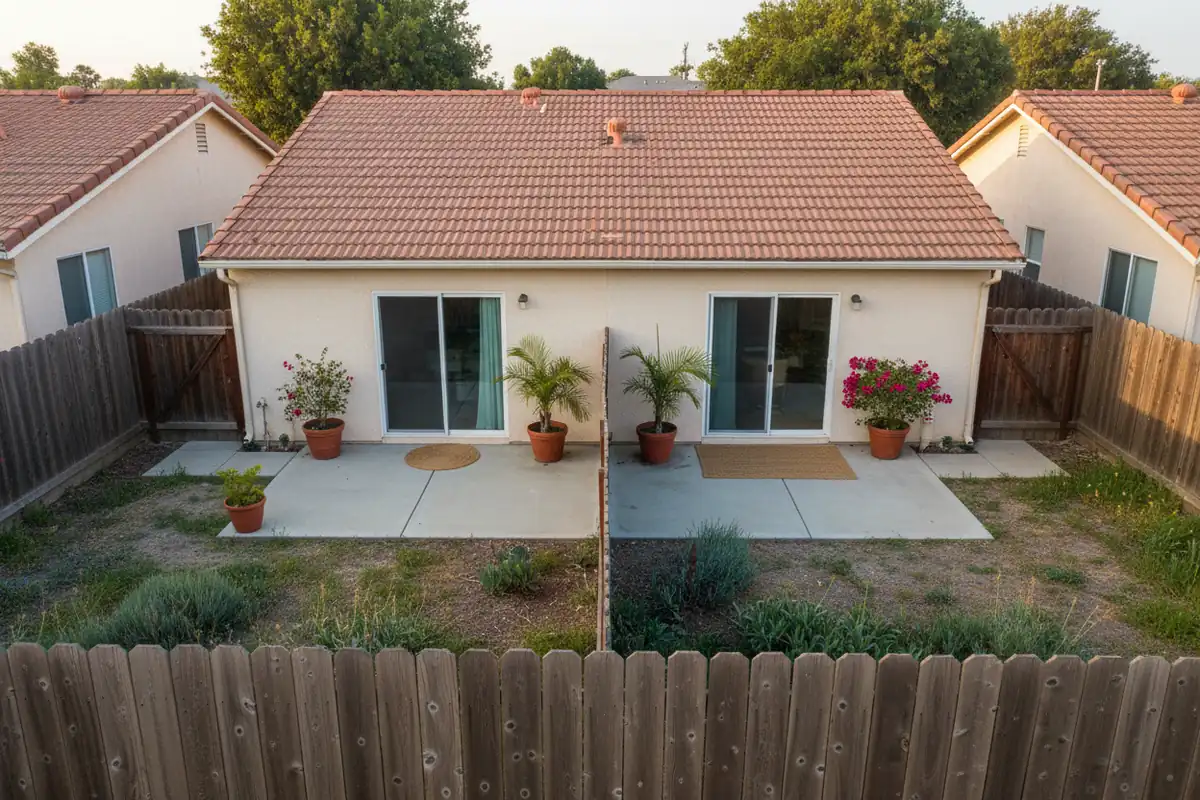
A duplex appraisal is a written opinion of the market value of a two-unit residential property, prepared by an appraiser as of a specific date. Because a duplex earns rent from two units, the appraiser usually looks at comparable two-unit sales and at the income the property can produce, not only at its size and condition.
On this page
Key Takeaways
A duplex is a two-unit residential property on a single parcel: both units held under one ownership and identified by one assessor parcel number, the number the county uses to identify a parcel on its records.
- A formal appraisal is a distinct product. It is not an automated valuation model (an AVM, a computer-generated estimate built from public records and sales data), a comparative market analysis (a CMA, a real estate agent's review of recent sales), or the assessed value the San Diego County Assessor places on the tax roll.
- Two lenses apply. A duplex appraisal looks at the property's physical features and at its income-producing potential. A single-family appraisal does not always apply the second lens.
- Purpose sets the scope. Common reasons include a sale or purchase, a refinance, an estate or probate matter, a trust, a divorce or dissolution, and a property tax appeal.
- Location matters. A duplex in Ocean Beach, North Park, El Cajon, Santee or Chula Vista draws on a different pool of comparable sales.
When This Option Fits
A sale or purchase is the most familiar trigger. When a buyer finances the purchase, the lender usually orders its own appraisal. An owner can also order an independent appraisal before listing or negotiating, which sets a reference point that belongs to the owner rather than the lender.
An estate or probate matter often calls for a value as of the date of death. In a probate, "The probate referee shall appraise all property other than that appraised by the personal representative"; an AVM or a CMA does not serve that purpose. The court process and the probate inventory are subjects for the estate's attorney.
Trust administration raises a similar need. A trustee working out the value of real property held in the trust often relies on a formal appraisal; a trust property appraisal follows the same logic for other property types.
A divorce or legal separation in California can turn on the value of community property, and counsel often requests a formal appraisal. A contested valuation is a matter for each spouse's attorney.
A property tax appeal is another fit. An owner who believes the Assessor's enrolled value is higher than market value can bring the question to the San Diego County Assessment Appeals Board, and an appraisal is the kind of evidence that supports the challenge.
Where a duplex sits alongside an accessory dwelling unit, the scope may need to address what the ADU contributes; an ADU appraisal covers that configuration.
A duplex appraisal is not the tool for a rent survey, a property inspection, a broker price opinion for listing purposes, or legal advice. Each of those comes from a different professional.
How It Works, Step by Step
The process for a two-unit property runs in a fairly steady order, from naming the purpose to receiving the report.
- The purpose and intended use. The reason for the appraisal shapes its scope and its effective date, the date the value opinion speaks to. A sale or refinance usually uses a current date; an estate usually uses the date of death.
- The property information. This includes the assessor parcel number, current leases or rent rolls if the units are rented, any prior appraisals, and permits for improvements or an ADU.
- The inspection. The appraiser visits both units, measures, photographs and notes condition. Access to each unit is typically needed, which may mean arranging entry with tenants.
- The three approaches to value. The sales comparison approach looks at recent sales of similar duplexes in San Diego County. The income approach converts the property's rent into a value, through a gross rent multiplier or by capitalizing net income. In plain terms, a gross rent multiplier relates the sale prices of comparable rented properties to their rent, and that relationship is applied to the subject property's rent. Capitalizing net income works from the rent left after operating expenses and divides it by a capitalization rate, the rate of return the market implies for similar properties. The cost approach adds land value to the cost of the buildings, less depreciation.
- The written report. The appraiser states an opinion of value as of the effective date. The Uniform Standards of Professional Appraisal Practice (USPAP), the national standards appraisers follow, govern how the report is prepared.
- Delivery and use. Who receives the report depends on who ordered it. A lender orders and controls its own appraisal; for an estate, a trust or a divorce, the party who ordered it receives it.
Costs, Timing and Trade-offs
What a duplex appraisal costs depends on the work it takes. The main drivers are the size and complexity of the property, the number of units, whether the units are occupied or vacant, how many comparable two-unit sales exist nearby, and the purpose. An appraisal for litigation or an estate can call for more analysis than one for a routine refinance. The factors behind home appraisal cost apply here, with the income analysis added.
Timing turns on the appraiser's availability, how quickly both units can be accessed, the complexity of the income analysis, and the time to write the report. A tenant-occupied duplex adds a scheduling step a vacant one does not.
Two trade-offs come up often:
- Lender-ordered or owner-ordered. A lender-ordered appraisal is typically paid for by the borrower and the lender is the client, though for credit "secured by a first lien on a dwelling" a creditor "shall provide an applicant a copy of all appraisals and other written valuations developed in connection with" the application. An owner-ordered appraisal is paid for by the owner, and the owner is the client.
- Formal appraisal or estimate. Speed and cost favor an AVM or a CMA, while formal purposes generally call for an appraisal.
The Assessor's enrolled value is a separate number again. It is the taxable value on the roll, set under California's property tax rules, and it is not necessarily the same as current market value, and not a substitute for an appraisal.
Options to Compare
Each way of valuing a duplex has a genuine use and a limit. None of them is the answer for every owner.
| Option | What it is | Where it is used | Its limit |
|---|---|---|---|
| Formal appraisal | A USPAP-compliant report signed by an appraiser | Lenders, courts, estates, trusts, tax appeals | The most involved and usually the most costly |
| Automated valuation model | An algorithm's estimate from public records and sales data | A quick, low-cost or no-cost first look | Not accepted for most formal purposes; may miss duplex income |
| Comparative market analysis | A real estate agent's review of recent sales | Listing strategy and pricing discussions | Not an appraisal; not used for probate, divorce or lender purposes |
| Broker price opinion | A real estate agent's value opinion, sometimes ordered by a lender | Certain loan decisions | Not a full appraisal |
| Assessor's enrolled value | The taxable value on the property tax roll | Understanding the tax bill | Reflects California's tax rules, not necessarily current market value |
A formal appraisal carries the most weight where someone else must rely on the number. An AVM or a CMA can help an owner orient early, before deciding whether a formal report is needed. Owners selling a duplex privately sometimes order an appraisal for a private sale to set that reference point.
Comparing written estimates of fees and timing, and, where a sale is involved, estimated net proceeds after commissions, repairs, carrying costs, loan payoffs and closing costs, is how an owner sees which approach fits the situation.
What to Have Ready
An appraisal request for a duplex is easier to scope when the basic facts about both units are at hand. Having these items available typically supports a smoother appraisal process:
- Assessor parcel number. It appears on the property tax bill and in the San Diego County Assessor-Recorder-County Clerk's property records.
- Leases or rental terms. Written leases or month-to-month terms for each rented unit show the income the appraiser analyzes.
- Expense records. Utility bills or expense records matter where the owner pays any utilities.
- Permits and records of improvements. Permits, certificates of occupancy and improvement records matter most for an ADU addition or a conversion.
- Prior appraisals. An earlier report, if one exists, shows how the property was described before.
- Purpose and effective date. The date of death for an estate, or a current date for a sale or refinance.
- Tenant contact details. These help where entry to occupied units must be arranged.
Gathering these papers can feel like one more task on top of an estate or a separation. Most of them already sit in a lease folder or a tax bill envelope.
Local Context: Duplex Appraisals in San Diego County
San Diego County holds two-unit properties in very different settings. In the City of San Diego, coastal and central neighborhoods such as Ocean Beach, North Park, South Park, University Heights and Mission Hills each have their own comparable-sale pool, shaped by lot sizes, building age and location. Inland, El Cajon, Santee and Chula Vista draw on separate pools again. A duplex in North Park and a duplex in El Cajon are compared against different sales, and a sound appraisal stays within the right neighborhood where enough sales exist. Where they do not, the approach resembles an appraisal for unique homes.
The San Diego County Assessor-Recorder-County Clerk (sdarcc.gov) keeps property records, parcel maps and assessment rolls, the usual starting point for confirming ownership, the assessor parcel number and the enrolled value. An owner in Ocean Beach, Santee or Chula Vista who believes that enrolled value exceeds market value can learn about the Assessment Appeals Board process through the Clerk of the Board of Supervisors. The county's official portal, sandiegocounty.gov, carries county property and planning information.
ADUs add a local layer. California's ADU legislation, including AB 1033, forms part of the background for properties that pair a primary home with an accessory unit. Where a property includes an ADU, its classification and the appraiser's scope may differ from a traditional duplex, and an appraiser decides how the ADU is reflected in value.
A practical next step on this subject is the property's own record: the assessor parcel number and enrolled value on the latest tax bill, along with any permits for a second unit, frame the first question to raise about scope.
Take the next step
Ready to take the next step with your property?
Tell us about the property and why you need an appraisal, so an independent appraiser can confirm the right scope of work.
How it works
- The propertyIts address and its type.
- The purposeA sale, an estate or probate, a divorce, a trust, tax or a legal matter.
- Your timelineWhen the appraisal is needed.
Take the next step
How we work
- Every request is reviewed by a person. Nothing on this site calculates a value automatically.
- Appraisals are prepared by independent, state-licensed or certified appraisers, never by this website.
- Estimates and cash offers are clearly labeled — never presented as appraisals.
- A request does not commit you to anything.
Frequently asked questions
What are the different types of appraisals for a duplex?
The types follow the purpose: a sale or purchase, a refinance, an estate or probate matter, a trust, a divorce, or a property tax appeal. Each purpose shapes the effective date and the intended use stated in the report. The methods stay the same, but the weight given to sales comparison, income and cost can vary.
How does a duplex appraisal differ from a single-family home appraisal?
The income approach is the main difference. Because two units produce rent, the appraiser analyzes lease terms and rental income alongside the sales comparison approach. The comparable sales are two-unit properties, not single-family homes, so the comparable pool is narrower.
What is the 1% rule for multifamily property?
It is an informal investor screening shortcut that compares monthly gross rent with the purchase price. It is not an appraisal method and plays no part in a USPAP-compliant report. A formal appraisal's income approach looks at net income and market capitalization rates instead.
What should I not say to an appraiser?
Pressing an opinion of what the property should be worth adds nothing, because the appraiser forms an independent opinion. Accurate facts help: recent improvements, permit history and current rents. Trying to steer the conclusion toward a number runs against the independence an appraisal depends on.
Can I get my duplex appraised for free?
A formal appraisal is a professional service and carries a fee. Some online tools and AVMs give free estimates, but they are not appraisals and are generally not what probate, divorce, lender or tax appeal matters call for. The fee for a formal report depends on the property's complexity and the appraisal's purpose.
Does adding an ADU to a duplex affect the appraisal in San Diego County?
It can. An ADU adds a rentable unit and may change the property's classification, its comparable-sale pool and the income analysis. California's ADU legislation, including AB 1033, is part of the background. An appraiser determines how the ADU is reflected, based on the configuration, its permits and the appraisal's purpose.
How does the San Diego County Assessor's value differ from an appraisal?
The Assessor's enrolled value is the taxable value on the roll, set under California's property tax rules, and it reflects the tax base, which is not necessarily current market value. A formal appraisal states an independent opinion of market value as of a specific date, which is what a sale, an estate, a divorce or a tax appeal relies on.
When is a duplex appraisal required for an estate or probate matter in California?
A California probate generally calls for a value of real property as of the date of death, and the personal representative delivers the inventory to "the probate referee designated by the court." An AVM or CMA is not a substitute. The estate's attorney can say what a particular estate requires.