An owner looking at a number on a screen usually has a decision behind the search. That decision might be a sale or a refinance. It might be a divorce, where a house has to be divided. It might be an estate, where an executor or a trustee needs a figure for a parent's home, or it might be a property tax bill that looks wrong. This page explains what an online estimate actually measures and why it drifts from what a buyer will pay. It also covers when California law or a lender expects something more than a website's figure.
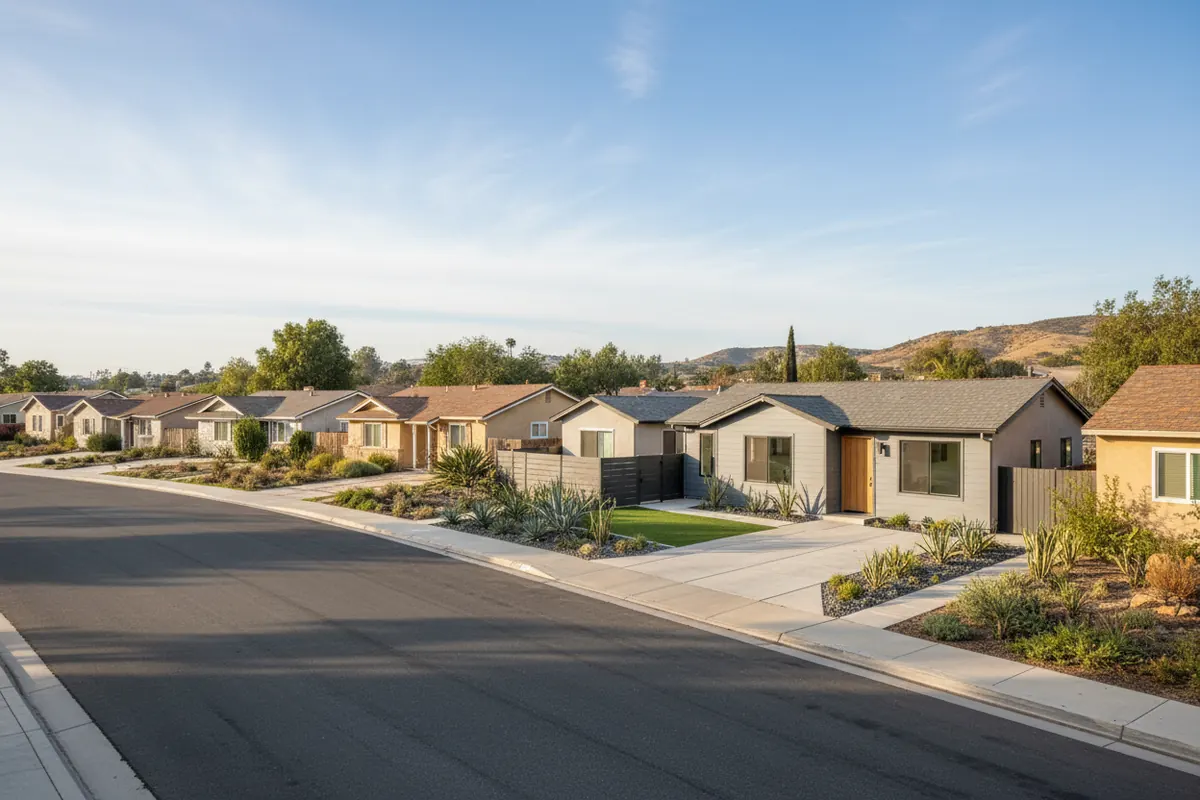
An online home value estimate is a rough starting range. It is not a reliable price. These tools work from public records and past sales, and they never see the inside of the house. Their accuracy depends on how many recent, similar sales sit nearby and how closely the home matches them. In much of San Diego County, that match is loose.
On this page
- What Home Value Estimates Are and How They Work
- Why Estimates Miss — and When the Gap Is Largest
- What the Law Says About Value in Specific Situations
- Online Estimate vs. Local Market Review — What Each One Shows
- How San Diego County Conditions Affect Estimate Accuracy
- Mistakes to Avoid When Using an Online Estimate
- What to Do Next
- Frequently asked questions
- Sources
What Home Value Estimates Are and How They Work
The number on a real estate website comes from an automated valuation model, or AVM. An AVM is a computer model that estimates a property's value from public records, recent sales data and listing information, with no physical inspection. The Zillow Zestimate and the Redfin Estimate are two familiar consumer AVMs. They are named here as examples only, not as a ranking.
An AVM draws on recorded sales, tax assessor data and listing history. For a given neighborhood, that data may be months old or incomplete. The model matches the home to similar sold homes and adjusts for the features it can read, such as square footage, bedrooms and lot size. It cannot observe condition, a recent renovation, which way the lot faces, the view, or anything else that never reached a public record.
Two other tools are often confused with an AVM. A comparative market analysis, or CMA, is a review prepared by a real estate agent. It compares the home with recent nearby sales and current listings. A formal appraisal is a written opinion of value from an appraiser who holds a state credential. The appraiser inspects the property and follows professional standards. The page on what your home is worth sets these tools side by side.
Why Estimates Miss — and When the Gap Is Largest
Errors come from the data itself, not from a fault in any one website.
- Sparse sales. Some neighborhoods have few recent sales. That is common in rural East County, in hillside communities and in coastal enclaves, and it leaves the model with less to work from.
- Hidden condition. A remodeled kitchen, an unpermitted addition, deferred maintenance or a fire-damage repair does not appear in public records until a permit is recorded or a sale closes.
- Market speed. In a fast market, the recorded sales the model uses may already lag current conditions by weeks or months.
- Unique homes. Custom homes, hillside lots, ocean or canyon views and mixed-use parcels are hard to match to comparable sales by formula.
- Data lag. Assessor records and listing data reach AVMs on different schedules. A recent sale may not show up in the model for weeks.
These causes tend to stack. The gap between an AVM figure and the final sale price tends to be larger in three cases. The first is a higher-value property. The second is a home in a low-turnover neighborhood. The third is a home whose condition differs sharply from its neighbors. A well-kept tract home on a busy inland street usually gives a model more to work with than a one-of-a-kind house on a canyon rim.
What the Law Says About Value in Specific Situations
For an owner going through a divorce or settling an estate, the useful question is what a documented, supportable valuation shows. A website's figure does not answer it.
Divorce. Family Code section 2552 says that, when the community estate is divided, "the court shall value the assets and liabilities as near as practicable to the time of trial." Under the same section, the court may value all or part of the assets at a date after separation and before trial. It may do so upon 30 days' notice by the moving party and for good cause shown. An online estimate is tied to whatever data the model last used, so it does not answer to either valuation date. A contested division is a matter handled by an attorney.
Probate and estates. Probate Code section 8900 provides that "The appraisal of property in the inventory shall be made by the personal representative, probate referee," or another appraiser the chapter allows. Evidence Code section 813 lists who may give an opinion of value. The list includes qualified witnesses and the owner or the owner's spouse. The page on estate and probate appraisals explains the inventory process in more detail.
Lending. Under 12 C.F.R. § 34.43, an appraisal by a state-credentialed appraiser is generally required for real estate-related financial transactions, "except those in which" one of its listed conditions applies. The exceptions include residential transactions with a transaction value of $400,000 or less, certain existing loans, and transactions that qualify for sale to a federal agency or a government-sponsored agency, and the list continues. For some excepted transactions, the regulation calls for an evaluation instead. So lenders often need an appraisal, but not always. The lender decides which rule applies to a given loan.
Online Estimate vs. Local Market Review — What Each One Shows
An online estimate is quick and broad. It gives a rough range from public data, it is there at any hour, and nobody has to visit the house.
A local market review goes further. It draws on current listings, pending sales and knowledge of the neighborhood that a model cannot capture. That gives a closer read on what buyers are paying in one part of San Diego County right now. A home value review by address is one example of this kind of reviewed local estimate.
The choice between an online estimate and a local market review mostly comes down to depth and how current the information is:
| Based on | Public records, recorded sales, listing history | Current listings, pending sales, local knowledge |
| Sees condition | No | Only as far as the information provided |
| How current | As current as the model's data | Current market activity |
| An appraisal | No | No |
Neither one is a formal appraisal. A formal appraisal is a written opinion of value prepared by a state-credentialed appraiser following USPAP, the Uniform Standards of Professional Appraisal Practice. Lenders, courts and tax authorities typically expect that document. For a sale decision, a local market review gives more current and property-specific context than an AVM alone. For a legal, lending or tax purpose, neither one replaces an appraisal. The page on residential property appraisals describes what one involves.
How San Diego County Conditions Affect Estimate Accuracy
San Diego County holds very different markets inside one county line. Coastal communities such as La Jolla, Del Mar, Encinitas and Coronado sit alongside inland suburbs such as Chula Vista, El Cajon, Santee and Escondido. There are also hillside and rural communities in East County and the backcountry, including Ramona and Alpine, and dense urban neighborhoods in the City of San Diego.
Each submarket has its own sales pace, price tier and inventory. Those conditions decide how much comparable-sale data an AVM has to draw on. A neighborhood in Oceanside or Carlsbad with steady turnover of similar homes gives the model plenty of matches. A view lot above Point Loma or a large parcel near Julian may have few true comparables, or none. Coastal and view properties often lack direct comparables, so algorithmic estimates there tend to be less reliable than in high-turnover inland neighborhoods.
The San Diego County Assessor records sales and updates assessed values on its own schedule. AVMs that pull from assessor records may therefore lag the real market. For an heir valuing a parent's home in Lemon Grove, or an owner refinancing in Mira Mesa, local data matters more than the national model behind the screen. The page on San Diego property appraisals covers the county more broadly.
Mistakes to Avoid When Using an Online Estimate
The most common mistake is reading the estimate as a price. An AVM figure is a model's output. It is not a buyer's offer and it is not a lender's commitment.
A second mistake is relying on an old figure. An estimate from months ago may not reflect how the market has moved since. A third is assuming the model knows about recent work on the house. A renovation finished last year may be missing from its data, and so may a roof that now needs replacing.
Relying on one platform causes trouble too. Comparing several tools shows whether they land in a similar range. When they disagree widely, the property is usually one the models find hard to value.
A more serious mistake is using an online estimate where an appraisal is required or expected. A divorce, an estate inventory, a loan or a tax question can each call for documented value, as the law section above describes.
The last mistake is confusing assessed value with market value. Assessed value is the figure the San Diego County Assessor uses for property tax. Market value is what a buyer would pay today. The two are calculated differently and often differ significantly. For a property-tax question, the Assessor's office is the place to ask.
What to Do Next
A reader whose question calls for a formal opinion of value can request an appraisal quote through San Diego Home Appraisal & Valuation's form. As a practical next step, the San Diego County Assessor's records show the property's recorded sales and assessment, along with the date of the latest sale a model may be relying on. Those records are worth comparing against any repairs or improvements that public records do not show.
Take the next step
Ready to take the next step with your property?
Answer a few questions and receive a reviewed market value estimate for your property.
How it works
- The propertyIts address, type, size, bedrooms and bathrooms.
- Its conditionFrom recently updated to needing significant work.
- Your reasonCurious, selling, refinancing or planning an estate.
Take the next step
How we work
- Every request is reviewed by a person. Nothing on this site calculates a value automatically.
- Appraisals are prepared by independent, state-licensed or certified appraisers, never by this website.
- Estimates and cash offers are clearly labeled — never presented as appraisals.
- A request does not commit you to anything.
Frequently asked questions
What is the most accurate home value estimator site?
No single platform is most accurate for every property. Accuracy depends on the neighborhood, the data available and how recently comparable sales were recorded. In San Diego County submarkets with few sales, all the major tools tend to show wider ranges. That is a limit shared by every AVM, not a mark against one site.
How does an online home value estimate differ from a formal appraisal?
An online estimate is a model's output based on public records and sales data, produced with no visit to the property. A formal appraisal is a written opinion of value by a state-credentialed appraiser who inspects the property and follows USPAP. Courts, lenders and tax authorities typically expect the appraisal.
Can I use an online estimate for a divorce property division?
Generally, an online estimate does not fit the standard. Family Code section 2552 ties value to the time of trial, or to another date the court allows, as explained above. An estimate built on stale data does not answer to either date. A contested division is handled by an attorney.
Is an online estimate enough for a probate or estate filing?
An online estimate is not the appraisal that Probate Code section 8900 describes. That section assigns the inventory appraisal to the personal representative, the probate referee or another appraiser the chapter allows. Evidence Code section 813 also lets the owner give an opinion of value.
Why does my online estimate differ from my property tax assessed value?
Assessed value is set by the San Diego County Assessor under California's property tax rules and is not designed to track current market value. An online estimate tries to model what a buyer would pay today. Because the two are calculated differently, they often differ significantly.
What devalues a house the most?
Several things reduce what buyers will pay. They include deferred maintenance, condition problems that public records do not show, location traits such as noise or traffic nearby, and the market conditions in that neighborhood. An AVM may miss most of these because it reads recorded data and never inspects the house.
What should I not tell an appraiser?
An appraiser forms an independent opinion of value. Inaccurate information about the home's condition, recent sales or improvements makes that opinion less reliable. The owner's part is to give accurate facts about the property. The appraiser's part is to observe and analyze them.
How often are online home value estimates updated?
Update timing varies by platform. It depends on when new sales, listing changes and assessor records reach the model. In San Diego County, a recorded sale may take weeks to appear in that data. An estimate can therefore trail the market even when it was refreshed recently.