Skip to content
San DiegoHome Appraisal & Valuation

California

Development Land Appraisal

Updated November 17, 2026

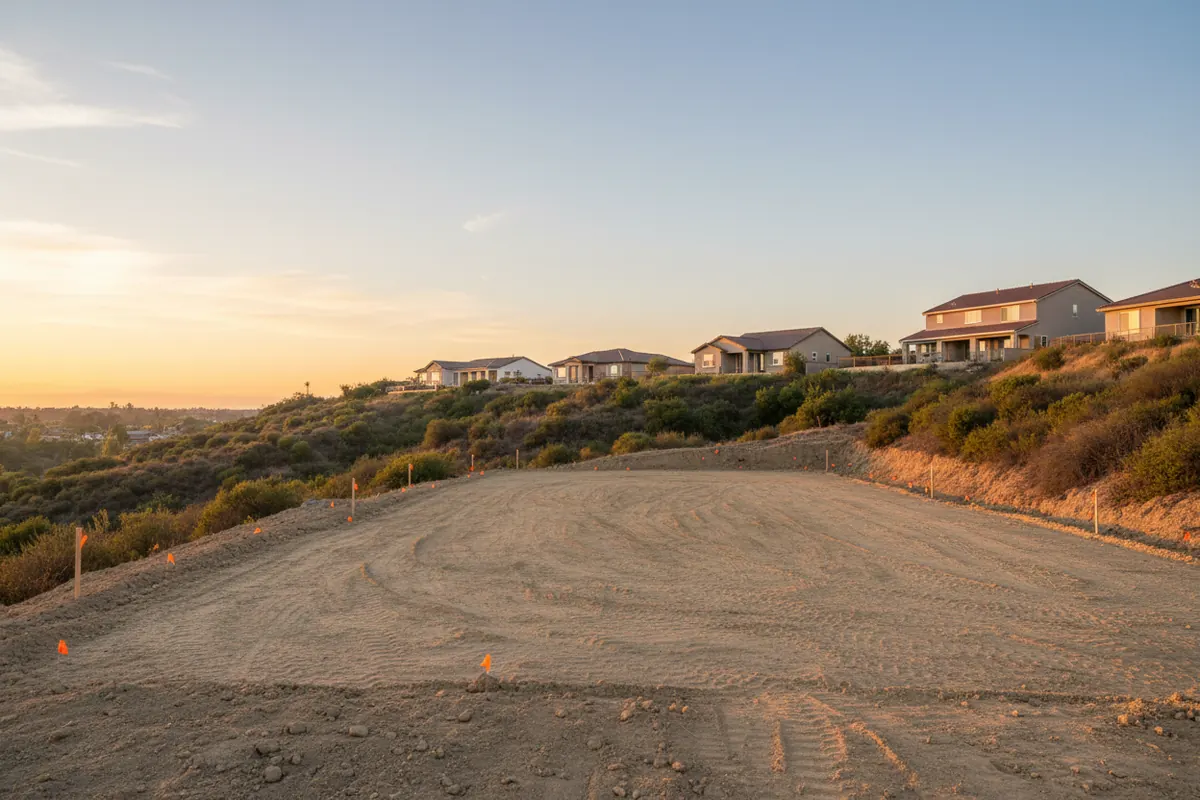
A graded hillside pad with survey stakes, land whose future use shapes its value.
Immediate answer

A development land appraisal is an appraiser's written opinion of what a parcel of raw or underimproved land is worth, based on what the land could legally and physically support rather than on any building that stands on it today. It is the kind of appraisal used when land is held or considered for development.

On this page
  1. Key Takeaways
  2. When This Option Fits
  3. How It Works, Step by Step
  4. Costs, Timing and Trade-offs
  5. Options to Compare
  6. What to Have Ready
  7. Local Context
  8. Frequently asked questions

If you hold land in San Diego County, perhaps a vacant lot you inherited, an acreage parcel in a trust you now administer, or a lot you own with a partner who wants out, the question in front of you is rarely "what is the house worth." It is what the ground itself could become, and what that potential is worth on a specific date to a court, a lender, a buyer or the county. That is a harder question than a standard home appraisal answers, and the answer depends heavily on where in the county the parcel sits.

This page explains what a development land appraisal looks at, the situations that call for one, how the work usually proceeds, what shapes its scope, how it compares with other ways of estimating value, and what information helps.

Key Takeaways

A development land appraisal values land held or considered for development. A standard improved-property appraisal centers on an existing house and its features; here the land, and what could be built on it, is the subject.

The analytical center of the work is highest-value use: the use of the parcel that is legally permissible, physically possible, financially feasible and most productive. In plain terms, the question is what the zoning allows, what the site's size, slope and access can physically accommodate, whether that use would make economic sense, and which of the remaining possibilities produces the highest value.

Zoning drives much of that answer, and zoning in San Diego County is not one set of rules. The unincorporated county, the City of San Diego and each incorporated city, such as Chula Vista or Escondido, keep their own zoning and general plan. Two parcels of similar size can carry very different development potential depending on the jurisdiction.

This type of appraisal is used in sales and purchases of land, estate and probate matters, trust administration, divorce or partnership dissolution, financing and refinancing, and property tax appeals. Each use shapes the report type and the date the value is stated as of.

When This Option Fits

A development land appraisal is typically sought in these situations:

  • Sale or purchase of raw or underimproved land. A seller or buyer wants an independent opinion of what the parcel's development potential is worth.
  • Estate or probate valuation. An executor or administrator needs the land valued as of the date of death.
  • Trust administration. A trustee needs a value for land held in a trust; a trust property appraisal follows similar principles for improved homes.
  • Divorce or partnership dissolution. Spouses or partners need a shared reference figure for land one of them may keep.
  • Property tax appeal. An owner questioning a tax-base figure wants an independent market value opinion.
  • Senate Bill 9 lot split or ADU feasibility. An owner wants to know how the potential for a second lot or an accessory dwelling unit affects the land's value.
  • Financing or refinancing of land. A lender needs a value for the land as collateral.

When a house sits on a lot, the appraisal usually centers on that house. When the land's potential exceeds what currently stands on it, or nothing stands on it at all, the analysis turns to the land itself.

Parcel type also shapes the work. An urban infill lot in the City of San Diego, surrounded by recent sales of similar lots, is a different assignment from a large unincorporated parcel in Ramona, Valley Center, Fallbrook or near Otay Ranch, where size, terrain, access and entitlement status vary widely.

How It Works, Step by Step

For an owner, trustee or executor, the process usually unfolds in the order below, though the appraiser decides the scope each assignment requires.

Step 1: Identify the parcel. The work starts with the details that pin down exactly which land is in question: the assessor parcel number (APN, the number the county uses to identify each parcel), the legal description (the written boundary description in the deed), the current zoning designation and the general plan land use designation. Those last two come from the jurisdiction the parcel sits in: San Diego County for unincorporated land, the City of San Diego, or an incorporated city such as Chula Vista, El Cajon, Escondido or Oceanside.

Step 2: Highest-value use analysis. This is where the parcel's potential is tested against the four-part standard described above. For residential land, two statewide developments now enter this step. Senate Bill 9 expanded lot-split and duplex rights on certain single-family parcels statewide, including in San Diego County. Accessory dwelling unit (ADU, a second, smaller home on the same lot) potential is also now a recognized factor in many residential land appraisals; an ADU appraisal covers the improved-home side of that question.

Step 3: Sales comparison approach. Next comes the search for land sales that resemble the parcel, with adjustments for differences in size, zoning, location, entitlements (approvals already granted, such as a tentative map) and development potential.

Step 4: Income or subdivision development analysis. Where the parcel's scale or entitlement status supports it, the value of the land may also be modeled on the lots or income a development could produce. In plain terms, this approach works from the finished project back to the raw ground: it considers what the lots or units a development could create might bring, and what it would take to get there. For example, a larger parcel that could be divided into several lots may be analyzed by looking at what those individual lots could be worth once created, then accounting for the work and time needed to create them. This step is often most relevant where comparable sales of similar raw land are sparse, because it offers a second way to test the value suggested by the sales comparison approach.

Step 5: Written report. The result is a written report stating the opinion of value as of a specific effective date.

That effective date matters. For estate, probate and tax purposes, the value often has to be stated as of a past date, and an appraisal stated as of a past date is called a retrospective appraisal.
Costs, Timing and Trade-offs

The scope of a development land appraisal, and with it the cost and the time involved, depends on several factors:

  • the size of the parcel;
  • how complex the highest-value use analysis is;
  • how many comparable land sales are available;
  • whether entitlements, environmental studies or soils reports are involved.

A simple infill lot in an established City of San Diego neighborhood typically calls for less analysis than a large unincorporated parcel in Jamul, Alpine or Borrego Springs, where comparable land sales may be sparse and the appraiser has to look farther afield or make larger adjustments. The general factors behind fees are discussed further under home appraisal cost, and parcels with few comparable sales share some of the challenges described for appraisals of unique homes.

Report type is the main trade-off. A full narrative appraisal report explains the data, reasoning and conclusions at length, and it is the form generally used where a court, a lender or the IRS will rely on the value. A shorter restricted-use report is written for a narrower audience and may not be accepted for those purposes. The shorter form can suit an internal planning question; it can fall short when someone outside the owner's circle has to rely on the figure.

What a particular court, tax filing or lender requires of the report is a question for the attorney, tax professional or lender involved in that matter.

Options to Compare

Several tools produce a number for a parcel, and each answers a different question for the person holding the land.

ToolWho prepares itWhat it considersTypical use
Development land appraisalAn appraiserHighest-value use, zoning, entitlements, comparable land salesCourt, lender, IRS and estate matters; sales of land
Standard residential appraisalAn appraiserThe existing home and comparable home salesPurchases and refinances of improved homes
Broker price opinion (BPO) or comparative market analysis (CMA)A real estate agentRecent listings and salesInformal pricing decisions; not an appraisal
Assessed valueSan Diego County AssessorThe property tax base under Proposition 13 reassessment rulesProperty tax bills; not a market value opinion
Automated valuation model (AVM)A computer algorithmSales data patternsQuick informal estimates; does not account for zoning, entitlements or highest-value use

A standard residential appraisal may not fully capture the land's development potential. A BPO or CMA can help an owner think about pricing, but it is not an appraisal. The assessed value is a tax-base figure and can differ substantially from market value. An AVM is fast but blind to the features that drive land value.

The San Diego County Assessor-Recorder-County Clerk (ARCC) maintains parcel records, and the county and city planning offices maintain zoning data. These are public records, and an appraiser uses them as a starting point.

A reader can request an appraisal quote through San Diego Home Appraisal & Valuation's form; the site itself does not appraise land, set a property's value or give legal or tax advice.

What to Have Ready

An appraisal request on land moves more clearly when these items are gathered:

  • Assessor parcel number (APN). It is available from the San Diego County Assessor-Recorder-County Clerk (ARCC) at sdarcc.gov.
  • Zoning and general plan designations. For unincorporated parcels, they come from San Diego County Planning & Development Services; for City of San Diego parcels, from City of San Diego Development Services; for an incorporated city such as Oceanside or Chula Vista, from that city's planning department.
  • Entitlements and studies. These include any tentative maps, environmental reports or soils studies already prepared.
  • Legal description. It appears on the grant deed or the title report.
  • Purpose of the appraisal. Sale, estate, probate, divorce, tax appeal or financing; the intended use affects the report type and effective date.
  • Date of death, for an estate or probate. The value is stated as of that date.

Many owners find that looking up the parcel's APN and current zoning designation on the ARCC site or the relevant planning department's public portal is a useful first step before an appraisal quote is requested, because those two data points shape the scope of the work.

Local Context

San Diego County includes incorporated cities, among them the City of San Diego, Chula Vista, El Cajon, Escondido, Oceanside, Vista, San Marcos, Santee, La Mesa and National City, plus a large unincorporated area governed by the county's own general plan and zoning ordinance. Each jurisdiction maintains its own zoning code and general plan, so a parcel's development potential depends on which one it sits in.

Senate Bill 9 is a statewide law that allows qualifying single-family parcels to be split into two lots, or developed with up to two units per lot, in most California cities and counties, including San Diego County. It has added a new layer of analysis to residential land appraisals here. ADU rules, set by state law and carried out locally, have also expanded development potential on many residential parcels, and an appraiser considers ADU potential as part of highest-value use where it applies. The California Department of Housing and Community Development (HCD), at hcd.ca.gov, is the state agency that administers ADU and Senate Bill 9 guidance.

Development land in the county falls into broad submarkets:

  • Coastal: La Jolla, Del Mar, Encinitas, Carlsbad
  • Inland valleys: El Cajon, Santee, Lakeside
  • North County: Escondido, San Marcos, Vista, Fallbrook, Valley Center
  • South County: Chula Vista, National City, Otay Ranch; see Chula Vista property appraisals
  • East County and rural unincorporated areas: Ramona, Alpine, Jamul, Borrego Springs

A coastal lot in Del Mar and an acreage parcel near Borrego Springs raise different questions about comparable sales, access and permitted use. Parcel and recorded-document data come from the ARCC at sdarcc.gov; zoning for unincorporated land comes from San Diego County Planning & Development Services at sandiegocounty.gov; and City of San Diego zoning comes from its Development Services at sandiego.gov.

Take the next step

Ready to take the next step with your property?

Tell us about the property and why you need an appraisal, so an independent appraiser can confirm the right scope of work.

How it works

  1. The propertyIts address and its type.
  2. The purposeA sale, an estate or probate, a divorce, a trust, tax or a legal matter.
  3. Your timelineWhen the appraisal is needed.

How we work

  • Every request is reviewed by a person. Nothing on this site calculates a value automatically.
  • Appraisals are prepared by independent, state-licensed or certified appraisers, never by this website.
  • Estimates and cash offers are clearly labeled — never presented as appraisals.
  • A request does not commit you to anything.

Frequently asked questions

How much does it cost to get a land appraised?

The cost depends on the parcel's size, location, zoning complexity and the scope of the highest-value use analysis, not a flat rate. A simple infill lot usually requires less work than a large rural parcel with sparse comparable sales. A quote request describing the parcel and purpose is how a scope-specific figure is obtained.

Is hiring an appraiser worth it?

It depends on who will rely on the number. A written appraisal is the instrument generally used for court, lender, IRS, estate and probate purposes. For an informal pricing decision, a broker price opinion or an automated estimate may be enough, though neither analyzes highest-value use or development potential.

How long is an appraisal valid?

An appraisal states value as of one effective date, so its usefulness depends on purpose. Lenders set their own requirements for how recent a report must be. For estates and transfers, what matters is the effective date relative to the triggering event, such as the date of death or the date of transfer.

What not to tell an appraiser?

An owner's asking price, purchase price or hoped-for value has no place in the appraiser's analysis, because the appraiser forms an independent opinion. What does help is factual: the APN, current zoning, any entitlements or studies, and the intended use of the appraisal, whether sale, estate, tax appeal or financing.

How does a development land appraisal differ from a standard home appraisal?

The difference is in the subject. A standard home appraisal looks mainly at the house and comparable home sales; a development land appraisal looks at the ground, drawing on zoning, entitlements and comparable land sales to judge what could be built there.

What is highest-value use, and why does it matter for land in San Diego County?

It is the use that gives a parcel its highest value within what the law, the site and the market allow. In San Diego County it matters because the unincorporated county, the City of San Diego and the other incorporated cities each keep their own zoning, so the same analysis can reach different results depending on the parcel's location and entitlements.

Can a development land appraisal be used for estate or probate purposes?

Yes. For estate and probate purposes, the land is typically valued as of the date of death through a retrospective appraisal. Stating the intended use, whether estate, probate or trust administration, at the time of the request matters, because it affects the report type and effective date.

Does SB 9 affect how development land is appraised in San Diego County?

It can. Senate Bill 9 expanded lot-split and duplex rights on qualifying single-family parcels, and an appraiser considers that eligibility in the highest-value use analysis where it applies. Whether a specific parcel qualifies depends on its zoning, location and other factors.